

What Is Prophetic Art? – A Beginner’s Guide to Spirit-Led Creativity
May 23, 2025
What Is Prophetic Art? – A Beginner’s Guide to Spirit-Led Creativity
Introduction: I still remember the first time I saw someone painting during a worship service. I was a bit skeptical yet curious as a blank canvas was set up at the front of the church. As the music played, the artist prayerfully dipped her brush and began to paint sweeping colors and shapes. By the end of the service, an image had emerged – a vibrant waterfall cascading over dark valleys. Something about that painting moved me deeply, as if God was speaking through art. After the service, the artist shared how she felt the Holy Spirit guiding each stroke, turning her creativity into a form of prayer. That day, I discovered the beauty of prophetic art…a spirit-led creation that touched hearts in a way words alone couldn’t.
This guide is an invitation into that world of prophetic art – perfect for anyone who loves home décor that carries meaning, enjoys prayer and intercession, or wonders how creativity can intertwine with prophecy. We’ll explore what prophetic art is, its biblical basis and historical roots, its purpose in worship, and practical steps for how you, as a Christian artist (or even a beginner!), can create “kingdom creativity” in partnership with God. Along the way, we’ll highlight examples from artist Anne Reid Artist’s work that embody this spirit-led creativity. Let’s dive in!
What Is Prophetic Art? (Definition and Key Concepts)
Prophetic art can be simply defined as “art created with God.” In the words of Christian art mentor Matt Tommey, “prophetic art is creating art with God… a beautiful dance where, as artists, we do the thing that God has put on our heart through our creative process.” In other words, the artist creative process is not self-directed – they are listening to the Holy Spirit and letting Him inspire the theme, imagery, colors, and message of the artwork. The result is art that carries a message from God’s heart.
Prophecy in a biblical sense means hearing from God and conveying His heart to encourage, strengthen, or comfort others (cf. 1 Corinthians 14:3). So, prophetic art is visual prophecy – it’s “prophecy in an art form.” The painting, drawing, or sculpture itself becomes the vessel for a message from God. Unlike general religious art which might simply illustrate a Bible story, prophetic art is directly inspired by the Holy Spirit in the moment and created with a specific spiritual intent.
Importantly, it’s not about the style or subject matter, but the inspiration and purpose behind it. As one prophetic artist explains, “It’s prophetic art wherever it’s produced if the inspiration for it comes from the Holy Spirit and its purpose is to edify, encourage or comfort.” In fact, a work doesn’t even need to depict a literal biblical scene or symbol to qualify – it could be abstract swirls of color or an image from everyday life, as long as God is the one who inspired it and it carries His encouragement for someone. The focus is on heart and intent rather than a particular artistic technique.
Many prophetic artists will pray and ask God for a vision, word, or feeling before they begin creating. They might receive a mental picture, a specific scripture verse, or a Holy Spirit “nudge” about what to paint. The creative process then becomes an act of obedience and worship – the artist yields their talents to express that divine inspiration on the canvas (or whatever medium). As Matt Tommey puts it, “He [God] flows through us by the power of the Holy Spirit in order to inspire us, bring fulfillment to us in our unique design and release His transformative nature through us to touch the world around us.” In prophetic art, the Holy Spirit is the co-creator.
It’s also worth noting that prophetic art is about process over product. The goal is not just to make a pretty picture; it’s to connect with God and convey what He’s saying. The joy comes from creating with Him, whether or not the art is “perfect.” As Matt Tommey reminds artists, “Creating with the Holy Spirit is about process, not product… about continually cultivating ears to hear, eyes to see, and senses to feel what God is saying and doing… Then respond through your chosen creative process. That’s prophetic art.” So if you feel a tug on your heart to try this, don’t worry that you’re “not a good enough artist.” It’s more about a willing spirit than advanced skill. As you create, your skill can grow over time – but God cares more that you create with Him than what you create.
Anne Reid Artist’s Take on Prophetic Art
To make this definition even more concrete, let’s look at the perspective of Anne Reid, a prophetic artist based in Oakville, Canada. Anne describes her calling this way: she has “a deep joy to experience the glory realm, and to share that experience with others through her paintings.” In other words, her artwork is an overflow of encountering God’s presence (“the glory realm”) and inviting others into that encounter. Each painting is like a visual “testimony” of something she’s experienced with God or a truth from Scripture that God impressed on her heart.
For example, Anne’s painting “Intercessor” is a beautiful illustration of prophetic art in action. She created “Intercessor” as an abstract representation of the power of prayer and standing in the gap for others. Soft waves of blues and golds flow across the canvas, intertwining and moving as if guided by a divine current. “Intercessor” channels divine intercession, where spirit and form merge in a dance of surrender and strength. The central forms are fluid yet intentional, suggesting human vulnerability intertwined with divine presence. Anne even inscribed Romans 8:26 alongside the artwork, a scripture about the Holy Spirit interceding for us “with groans too deep for words.” The painting itself thus becomes a prayer on canvas, inspired by scripture and the Spirit. When you gaze at it, you sense the “unseen power of prayer through ethereal abstraction” – it’s meant to edify and encourage anyone who is praying for loved ones. This is a hallmark of prophetic art: the viewer can actually feel ministered to, as if God is speaking hope or peace or conviction to their heart through the image.
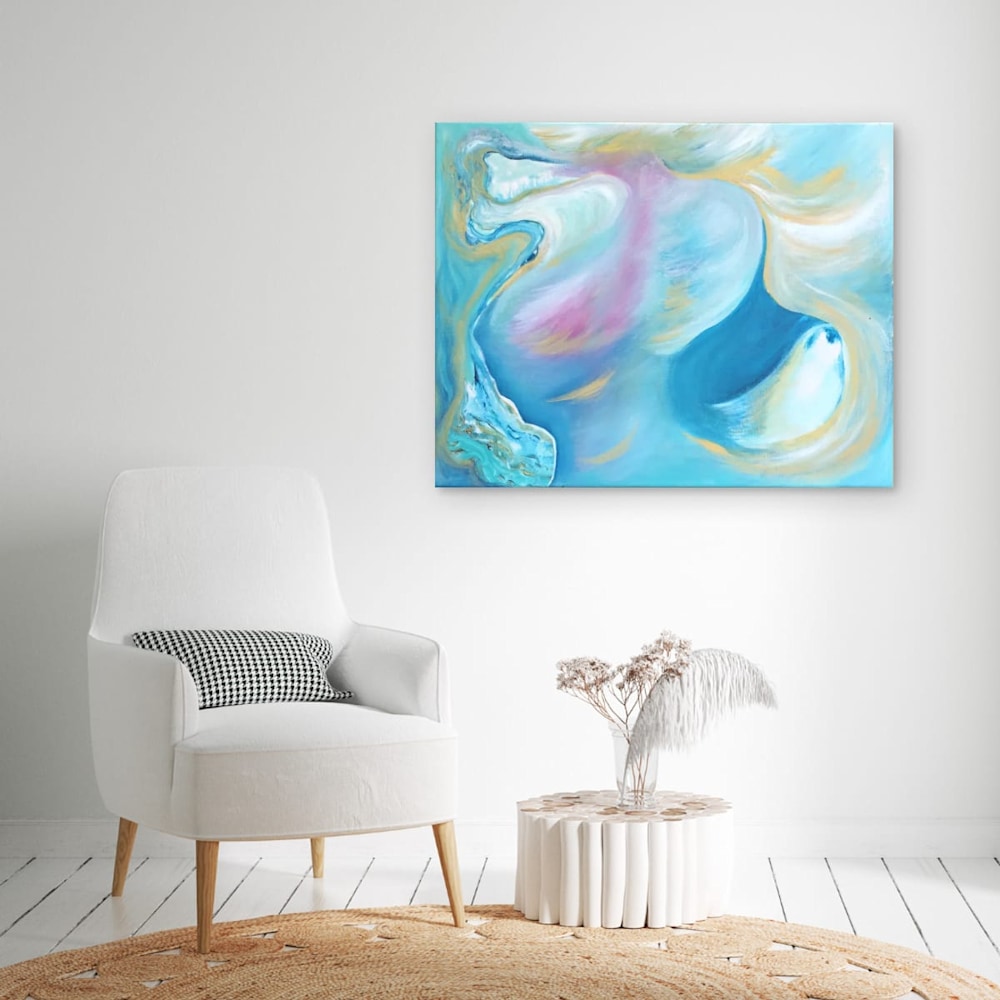
Anne Reid Artist’s portfolio is filled with other pieces that were birthed in prayer and prophetic inspiration. For instance, her piece “Pentecost” (available as a fine art print) depicts the fire of the Holy Spirit coming down – its vibrant reds and golds bring to mind the tongues of fire from Acts 2 and invite the viewer to experience fresh passion and empowerment. Another series, titled “Wilderness”, visually portrays God’s guidance of Israel in the wilderness (Exodus 13:21-22) – a reminder that God’s presence is with us in every season, day or night. A painting called “Deluge” shows a majestic waterfall of blues and whites, symbolizing a flood of God’s love and Spirit washing over dry places. And “Glory Cluster” features imagery of grapes and new wine, echoing the biblical metaphor of the new wine of the Spirit – it speaks of abundance, joy, and the fruitful overflow of God’s glory. Each title and image carries a message much larger than paint on canvas. Anne often prays over her artworks and sometimes shares the visions or Bible verses behind them, so that those who hang the art in their homes can also sense that spirit-led message in their space.
In summary, prophetic art is art as worship and art as a vessel of God’s voice. It’s intuitive, flowing, and led by the Spirit from start to finish. Whether you’re looking at a painting like those in Anne Reid Artists’s gallery or creating your own, the essence of prophetic art is the same: God speaks, we listen and create, and others are touched by the result. This has strong biblical foundations, which we will explore next.
Biblical Foundations and Historical Roots of Prophetic Art
Is there a basis for prophetic art in Scripture? While the term “prophetic art” is contemporary, the concept of Spirit-inspired creativity is woven throughout the Bible. From the very beginning, God revealed Himself as a Creator – “In the beginning, God created the heavens and the earth” (Genesis 1:1). And notably, the first attribute of humans made in God’s image was creativity: we see Adam tasked with naming animals (a creative act of expression), and throughout Scripture men and women crafted music, poetry, and objects under God’s inspiration. We are creative because we bear the image of a creative God. As author and musician Ray Hughes succinctly said, “God created us in His image. We have been created, by the Creator, to be creative.” If our Creator communicates and expresses Himself through beauty, order, and imagery, it’s natural that He can communicate to and through us in artistic ways as well.
One clear biblical example of Spirit-led creativity is found in the story of Bezalel in the Old Testament. When God instructed Moses to build the Tabernacle – the portable sanctuary – He didn’t just give engineering plans; He anointed specific artists to craft the holy objects. “See, I have chosen Bezalel… and I have filled him with the Spirit of God, with wisdom, understanding, knowledge and all kinds of skills – to make artistic designs…” (Exodus 31:2-5, NIV). This is profound: the very first person in the Bible said to be “filled with the Spirit of God” was an artist! God imparted His Spirit to empower Bezalel’s creativity in metalwork, wood, and other media for the Tabernacle. Bezalel, along with Oholiab and other artisans (Exodus 35:30-35), crafted things like the Ark of the Covenant, tapestries, priestly garments – all with divine inspiration and skill. While their work was not called “prophetic art” per se, it was art created under God’s direct guidance for a holy purpose.
We also see prophetic imagery and symbolic actions throughout the Bible, which relate to the idea of prophetic art. Old Testament prophets often saw visions and then described them in vivid detail (think of Ezekiel’s visionary scenes, Daniel’s apocalyptic beasts, or Joseph’s dreams). Those visions are essentially divine images meant to convey a message. Sometimes prophets even acted out prophecies visually: for example, Jeremiah buried and retrieved a linen belt as a sign (Jer. 13:1-11), Ezekiel drew a picture of Jerusalem on a clay tablet and enacted a siege (Ezek. 4:1-3), and Agabus in the New Testament tied his own hands with Paul’s belt to visually prophesy Paul’s imprisonment (Acts 21:10-11). These could be seen as a form of performance art directed by God. Such actions and images spoke louder than words alone. In a similar way, prophetic visual art today uses images, colors, and composition to communicate messages from God’s heart.
The Bible is also full of poetry and song (the Psalms, for instance) that were inspired by the Holy Spirit and often prophetic in nature. King David, a creative poet and musician, wrote, “I will sing a new song to you, O God” (Psalm 144:9). He appointed artists and musicians in the temple to continually worship God – and many times their songs carried prophetic anointing (some Psalms are considered messianic prophecies). This shows that creativity has long been a vehicle for prophecy and worship.
Historically, the Church has used art to convey spiritual truth from its earliest days. The early Christians in the catacombs painted symbols like the fish, anchor, or Good Shepherd on the walls to communicate their faith. In medieval times, iconography (painting of icons) was a prayerful practice – icon painters would fast and pray as they painted images of Christ or the saints, believing the Holy Spirit guided them (while icons are more traditional than spontaneous, the intent to invite God’s presence into art was there). The Renaissance produced majestic biblical art (think of Michelangelo’s Sistine Chapel or da Vinci’s Last Supper) – those artists often prayed and sought to honor God with their masterpieces, trusting God for skill. We might not label Michelangelo a “prophetic artist” in the modern sense, but he certainly saw his talent as from God and for God’s glory.
In more recent history, especially in the last few decades, there has been a resurgence of “prophetic arts” in worship settings. In the 1980s and onward, various charismatic and evangelical communities began embracing painting during worship services. Churches and ministries (such as the International House of Prayer, Bethel Church in Redding with Theresa Dedmon’s arts ministry, and many others) have encouraged artists to paint live on stage or create artworks as part of prayer gatherings. This modern movement explicitly calls these works prophetic art – art created while listening to God, often meant to deliver a timely message to the congregation or individuals. It’s become common to see paintings of lions, eagles, fire, rivers, crowns, and other biblical imagery emerge during worship, corresponding to what God is speaking in that moment. Sometimes the artist will explain the meaning after the service: for example, “While painting, I sensed God’s promise of healing flowing like a river, which is why I painted a river of light.” And often, people in the audience are amazed, saying “That image spoke exactly what I needed from the Lord!” This confirms the biblical principle that God’s gifts (including art) are meant to build up the church.
Even in secular galleries or public spaces, God can use prophetic art outside church walls. There are testimonies of people being drawn to a painting in a coffee shop or office and feeling inexplicably moved, only to find out the Christian artist painted it while praying for that very impact. In Theresa Dedmon’s book “Born to Create,” she shares a powerful story of a non-believing woman who encountered one of her paintings in a doctor’s office. The painting (aptly titled “Poppies of Delight”) had been painted with an anointing for healing. When the woman saw it, she was unexpectedly touched by God’s presence and received emotional healing regarding a past trauma. As Dedmon writes, “God restored [her] through a painting — not one hanging in church, but in a doctor’s office. Supernatural creativity has the power to breathe life into seemingly hopeless situations.” These stories echo the power of art to transcend time and space, carrying God’s voice wherever it goes.
To summarize the foundation: God anoints creatives. He always has. The Holy Spirit is the ultimate source of inspiration (“the breath/wind of God”), and when we create under His influence, our art can carry a supernatural impact. Prophetic art stands on the shoulders of a long lineage of Spirit-led creativity, from Bezalel’s craftsmanship to David’s psalms to modern-day painters in worship gatherings. It’s a natural extension of what God has always done – speaking to His people in diverse ways, including visual signs and artistry.
The Purpose of Prophetic Art in Worship and Ministry
Why incorporate art into worship or spiritual life? What purpose does prophetic art serve? Understanding the “why” will inspire you even more to appreciate and perhaps pursue this form of creativity. Prophetic art has several beautiful purposes in the context of worship and ministry:
- 1. To Glorify God through Creativity: First and foremost, creating art under God’s inspiration is an act of worship. It’s a way to glorify Him with the creative gift He’s given. When an artist paints during a worship service (or a craftsperson makes a beautiful piece unto God), it is offering back to God the talent He invested in them. It’s similar to singing a song of praise, except the song is visual. God delights in our creativity – “God is glorified and I am fulfilled when I create with Him,” says Matt Tommey. In heaven, God’s throne is surrounded by beauty and creativity (just read Revelation – there are rainbow colors, jewels, creatures with eyes, etc. around His throne!). Prophetic art brings a touch of that heavenly creativity into our earthly worship.
- 2. To Edify, Encourage, and Comfort People: As mentioned earlier, prophecy’s biblical purpose is to strengthen and encourage the Church. Prophetic art is “for the building up of others” just like verbal prophecy. A painting that comes from God’s heart can bring hope to someone in despair, confirmation to someone seeking guidance, or comfort to someone in grief. Many times, after a worship service where art was created, people will testify, “The image of the eagle you painted spoke to me – I felt God reminding me He’s giving me new strength to soar.” Or, “When I saw those painted healing waters, I started crying and felt God’s peace about my illness.” The art becomes a point of contact for God’s presence. In homes, hanging a prophetic art print can continue to minister daily – for example, placing Anne Reid Artist’s “Friend of the Bridegroom” piece in your living room might continually remind your family of the joy of being Jesus’s friend – thus the art continually points their heart to worship. Another piece, “Ruth and Boaz” might adorn a dining room wall and spark conversations about faithfulness, redemption, and heritage in Christ. In this way, the art isn’t passive decoration; it’s active storytelling and worship in one’s living space.